On May 28, 2026, AWS shut down AWS IQ, the talent marketplace that connected AWS customers with certified freelancers and small consulting firms for hands-on project work inside their AWS account. The console is closed, all in-flight engagements have either moved to AWS Marketplace Professional Services or off-platform, and anyone who used IQ is now looking for the right replacement. I sold on AWS IQ from 2023 with a 5-star rating across 6 reviews, and I am now an AWS Marketplace seller, so I have used both sides of the transition and can compare the options honestly.
Why AWS Shut It Down
AWS gave its reason directly: "After careful evaluation, we've made the decision to discontinue AWS IQ. This decision allows us to focus our investment for Professional Services in AWS Marketplace." This is consolidation, not cost-cutting. AWS Marketplace already runs professional services procurement at scale, and AWS wanted buyers and sellers on the same platform.
The practical consequence: every AWS IQ expert is already registered as an AWS Marketplace seller. If you have an existing relationship you want to continue, the person is still there. Only the procurement flow changed.
What AWS IQ Actually Offered (and Why It Worked)
I joined AWS IQ as a freelancer in early 2023. From the expert side, the experience worked a lot like Fiverr or Upwork: a feed of incoming customer requests, multiple experts responding to the same request with proposals, and the customer picking whichever proposal fit best. The matching was demand-driven. You did not pitch for projects; the requests came to you.
What made it useful for customers:
- Zero sourcing friction. You described your project, and certified experts responded with fixed-price proposals within hours.
- Built-in certification verification. AWS enforced the certification requirement. You did not need to check whether someone held the credentials they claimed.
- AWS account billing. Consulting charges appeared on your AWS bill, with no separate invoice.
- Scoped IAM permission grants. You approved a named role for a specific expert, and access auto-revoked when the project ended. Fully CloudTrail-audited.
Where it fell short: by 2023, the matchmaking feed had quality issues. Larger consulting shops flooded the request board, making it harder for individual specialists to stand out and harder for customers to distinguish a solo expert with deep AWS knowledge from a generalist firm running the engagement through a junior. A few of my clients mentioned they had tried IQ before finding me and had mixed experiences with other experts. The tension between platform volume and expertise quality was real by the end.
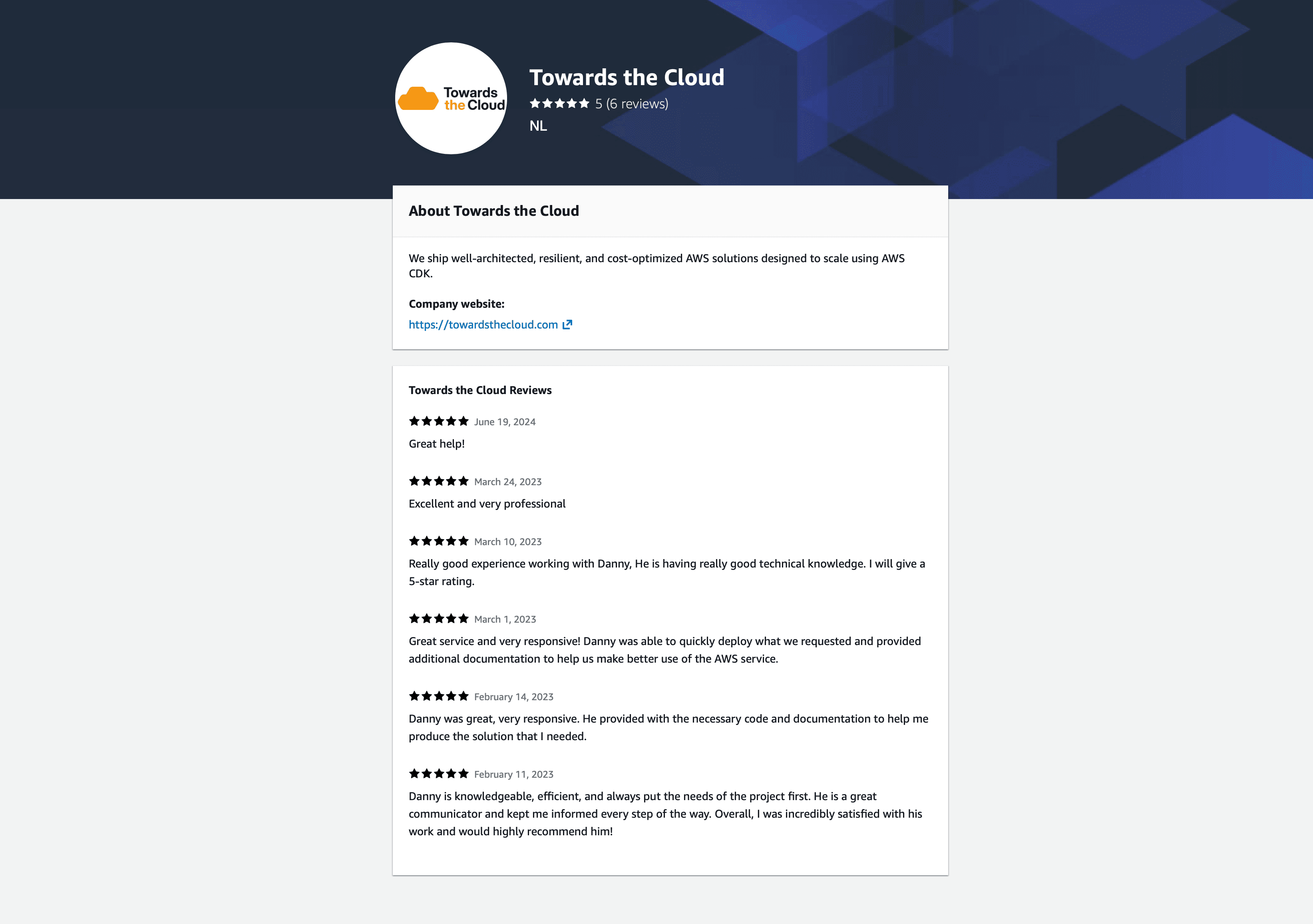
The core thing AWS IQ solved was the sourcing problem. What it could never fix was expertise quality at scale. That responsibility was always on the buyer, and it still is.
The Best AWS IQ Alternatives, Matched to Your Situation
The wrong alternative for your situation is worse than no alternative at all. The core variable is scope: a quick troubleshooting question and a three-month infrastructure migration need completely different solutions.
For Quick Technical Questions: AWS Business Support+ or Amazon Q
If you used AWS IQ for short-horizon troubleshooting ("why is my Lambda timing out," "is this security group configuration correct," "review this IAM policy"), the right replacement is AWS Support, not a consulting marketplace.
AWS Business Support+ starts at $29/month (or a percentage of your monthly charges, whichever is greater). You get 24/7 access to Cloud Support Engineers, less than 30-minute engagement for business-critical system-down cases, and 500+ Trusted Advisor checks. For the kind of question you might have posted as an AWS IQ request, this covers it at a lower per-question cost than a project proposal.
Amazon Q Developer handles code and architecture questions, with a free tier available.
AWS re:Post is free for non-urgent questions, a community Q&A service where certified AWS practitioners answer questions publicly.
The caveat: AWS Support plans cover troubleshooting and architectural guidance, not hands-on implementation inside your account. A support engineer will tell you how to fix your Lambda configuration; they will not log into your account and fix it for you. If you are weighing the trade-offs at the upper end, AWS Enterprise Support versus an AWS Partner engagement is a useful cost comparison at the $5,000/month entry point.
For a Specific Project: AWS Marketplace Professional Services
For a defined-scope engagement (a security review, a migration, a cost optimization sprint, a CDK codebase review), AWS Marketplace Professional Services is the AWS-recommended path. It is the closest functional replacement for how AWS IQ worked: on-bill, proposal-based, and the same 2.5% fee structure on the expert side.
The engagement flow inverts the IQ model. AWS IQ was inbound for sellers: you posted a request and experts came to you. AWS Marketplace is outbound for buyers: you find a seller and initiate contact. There is no request board. In practice, you browse the Marketplace Professional Services catalog, find a seller whose listing matches your needs, click Request private offer, and the seller contacts you within two business days. You negotiate scope and pricing directly, the seller creates a private offer targeting your AWS account ID, and you accept it with a single Create contract click. Charges flow through your AWS bill, visible in Cost Explorer.
If you had an ongoing engagement with a specific AWS IQ expert, contact them directly. They are already registered as a Marketplace seller and can create a private offer for the continuing work. You can find Towards the Cloud on AWS Marketplace as an example of what a seller profile and offer flow look like.
One thing changed in the migration that is worth knowing: AWS IQ's Milestone payment type does not exist in Marketplace. AWS is explicit about it: "The AWS IQ Milestone payment type is currently not available in AWS Marketplace Professional Services." The closest substitute is Variable payments, which let sellers submit payment requests as work progresses with either Manual Approval (explicit review) or Auto Approval (10-day window, then auto-approved). The functional outcome is similar, but the approval flow is configured at the offer level rather than per-milestone.
For Smaller Tactical Work: Upwork, Fiverr, Freelancer
AWS names Upwork, Fiverr, and Freelancer in its end-of-support guidance, and they are reasonable for smaller, clearly scoped engagements. Be honest about what you are getting, though: the quality range on these platforms is wide. Anyone can list themselves as an "AWS expert" without holding a current certification, the platforms do not verify credentials, and the bidding model rewards low prices over deep expertise.
Two things differ from AWS IQ in practical terms: payment is off-bill (a separate invoice, not your AWS bill), and certification verification is entirely your responsibility. For anything touching your production AWS account, ask for a Credly badge link and check it. A claimed certification without a verifiable Credly badge should be a hard stop.
LinkedIn Search: Often Overlooked
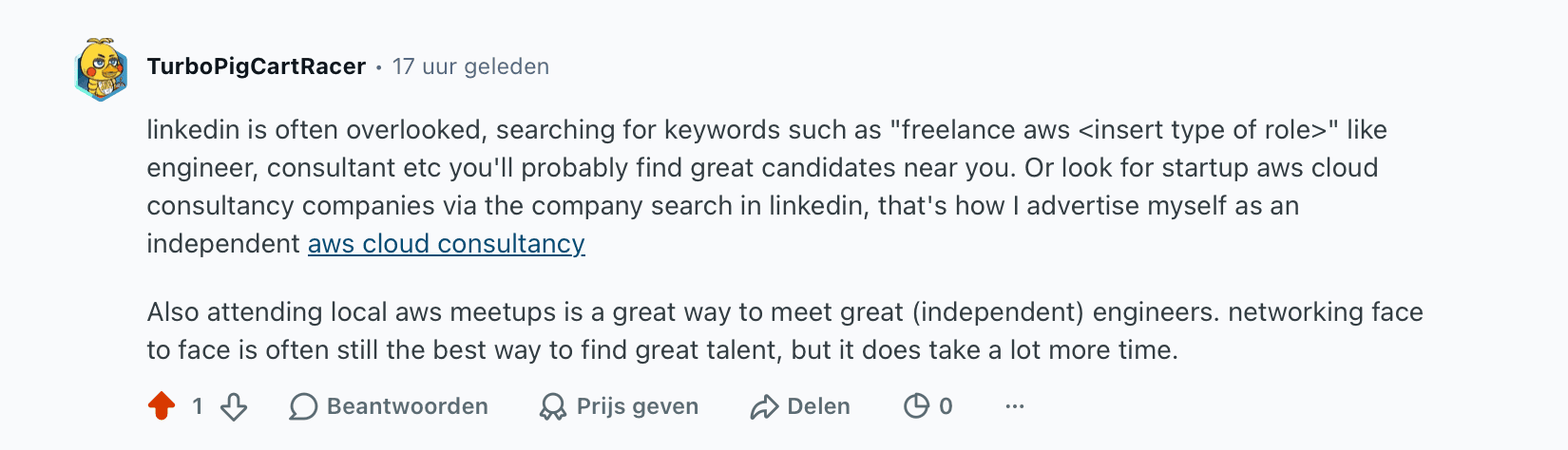
LinkedIn is genuinely underused for sourcing AWS specialists. Two search patterns work well:
- People search:
"freelance AWS <role>"(for example,"freelance AWS engineer","freelance AWS consultant","freelance AWS architect"). You will find independents in your region, often with their certifications, public projects, and a recommendation network you can sanity-check. - Company search: look for small AWS cloud consultancies. This is how I advertise Towards the Cloud as an independent AWS consultancy, and most other independents do the same.
The signal-to-noise ratio is higher than freelance marketplaces because LinkedIn is the person's professional identity, not a side-platform persona. You can see the work history, current AWS Partner status of any company they founded, mutual connections who can vouch, and whether they post about AWS topics with depth or just buzzwords.
This is also the advice I gave in r/aws when someone asked the same question:
Local AWS Meetups: Slower, But the Highest Quality
Attending local AWS meetups (and AWS Community Days, AWS Summits, AWS re:Invent if you can get there) is still one of the best ways to find independent engineers. Face-to-face networking takes more time and only pays off over months, but the people who show up are typically the ones who care deeply about AWS, run real workloads, and have a reputation among local peers. That reputation does not exist on a freelance marketplace.
Find meetups through AWS User Groups or by searching meetup.com for "AWS" in your city.
For Architecture Reviews and Infrastructure Builds: AWS Partner Network
For multi-week or multi-month engagements (architecture design, AWS Landing Zone builds, migrations, CDK/IaC projects, AWS security reviews), an AWS Partner Network (APN) partner is the right fit. This is where the quality bar is genuinely higher than anything a freelance marketplace can guarantee.
The distinction is certification versus company-level vetting. AWS certifications signal individual knowledge; APN tier signals company-level investment and verified customer delivery. To reach Advanced or Premier tier, a firm needs certified staff, verified customer references reviewed by AWS, and demonstrated experience at scale. AWS Specializations (Competency designations in areas like migrations, security, or SMB) require third-party technical assessments of multiple customer success examples.
A Canalys study cited by AWS found that 87% of customers rank AWS Specializations as a top-three criterion for partner selection. The Specialization badge signals "someone at AWS reviewed this firm's actual delivery work," not just "they have a certified employee."
One practical entry point worth knowing: AWS funds up to $5,000 per qualifying AWS Well-Architected Review for APN partners at Advanced tier and above. For SMBs, this means engaging an AWS Partner for a Well-Architected Review can be effectively free as an architectural assessment, a low-commitment way to start a consulting relationship.
Find APN partners at partners.amazonaws.com, filter by location, industry, and Specialization type. Partners typically respond within 2-3 business days. For a side-by-side breakdown of AWS Professional Services versus AWS Partner pricing, the cost difference is meaningful at the engagement size where AWS ProServe becomes available.
Trade-off to acknowledge: direct APN Partner engagements are off-bill. Payment goes via invoice directly to the partner, not through your AWS account. If AWS billing integration is a hard requirement, the Marketplace Private Offer path is the right combination.
For Ongoing Managed Services: AWS Partner MSP
If you need a long-term operations relationship (ongoing monitoring, incident response, cloud management), an AWS MSP Partner is the right fit. MSP Partners are validated for end-to-end managed services at any stage of the cloud journey: advisory, design, procurement, building, and operations.
For enterprise procurement above $250,000, AWS Marketplace Private Offers still work, but they require an additional approval step through AWS's Private Offer Success Team.
Comparison Table: AWS IQ vs the Alternatives
| Option | Vetting Level | AWS Billing Integration | Best Fit Project Size | Cost Structure | Response Time |
|---|---|---|---|---|---|
| AWS IQ (shut down) | Individual AWS certs required (AWS-verified) | Yes, AWS bill | Small to mid ($500–$50K) | 2.5% fee to expert; Milestone payments | Hours to days |
| AWS Marketplace Pro Services | Company listing (self-registered); APN tier visible if applicable | Yes, AWS bill | Any size | 2.5% fee to seller; no Milestone payment type | 2 business days |
| AWS Partner Network (direct SOW) | Company-level; Specializations require third-party review | No, off-bill invoice | Mid to large ($10K+) | Negotiated; no AWS fee | 2-3 business days |
| Upwork / Fiverr / Freelancer | Self-declared certs; platform reputation score | No, off-bill | Small ($200–$5K) | Platform fee | Hours |
| LinkedIn search / local meetups | None enforced; you verify Credly + history | Depends on the engagement | Any size | Negotiated direct | Days to weeks |
| AWS Business Support+ | AWS support engineers | N/A, support plan, not consulting | Break/fix questions only | $29/month min or % of charges | Under 30 min (critical cases) |
| Towards the Cloud (AWS Marketplace) | AWS Partner; multiple AWS certifications; 5-star IQ history | Yes, AWS Marketplace on-bill | Mid to enterprise | Custom private offer; 2.5% Marketplace fee | 2 business days |
How to Vet Any AWS Consultant (Without AWS IQ's Built-In Trust Signals)
AWS IQ's certification requirement was a minimum bar, not a quality guarantee. The same principle applies to every alternative: credentials tell you someone has passed an exam, not whether they communicate clearly, deliver on time, or understand your specific workload.
Certifications. Any consultant doing AWS infrastructure or architecture work should hold at minimum an AWS Certified Solutions Architect – Associate. For complex migrations and multi-account architecture, Solutions Architect – Professional is the more meaningful signal. All AWS certifications are issued through Pearson VUE and independently verifiable via Credly. Ask for the Credly badge link, not a CV bullet. Badges link to the issuing credential, exam passed, and expiration date. Certifications expire after three years, so check when theirs were last renewed.
APN Partner status. For engagements beyond a single freelance task (anything involving production workloads, multi-account architecture, security posture, or ongoing operations), an AWS Partner listing on partners.amazonaws.com gives you verifiable company-level trust signals. Select tier means certified staff and verified customer references. Advanced and Premier tiers add stronger certification requirements and proven customer experience at scale. More valuable than the tier itself are AWS Specializations, which require third-party technical review of multiple customer success examples and are not self-declared.
Public work. GitHub repos, conference talks, blog posts, podcast appearances. A consultant who writes or speaks about AWS publicly has a body of work you can evaluate before you ever get on a call.
Frequently Asked Questions
What was AWS IQ?
Can I continue working with the AWS IQ expert I used before?
What is the best free alternative to AWS IQ?
Does AWS Marketplace Professional Services verify AWS certifications?
What is replacing Developer Support and Business Support after they end?
Does AWS Marketplace support Milestone payments like AWS IQ did?
How do I find a good independent AWS engineer outside of marketplaces?
If you are looking for an AWS Partner for infrastructure work, migrations, cost optimization, or CDK-based builds, and want the billing simplicity of AWS Marketplace, you can find our profile at Towards the Cloud on AWS Marketplace and request a private offer directly.
Next step