Deploy the AWS CDK Landing Zone, a multi-account foundation your team can actually maintain.
Deployed to YC-backed clients such as:
Deployed to YC-backed clients such as:

Where the mess starts
A few clicks in the AWS Console are enough to ship the first workload.
Then dev, staging, and production begin sharing the same account, the same limits, and the same access patterns.
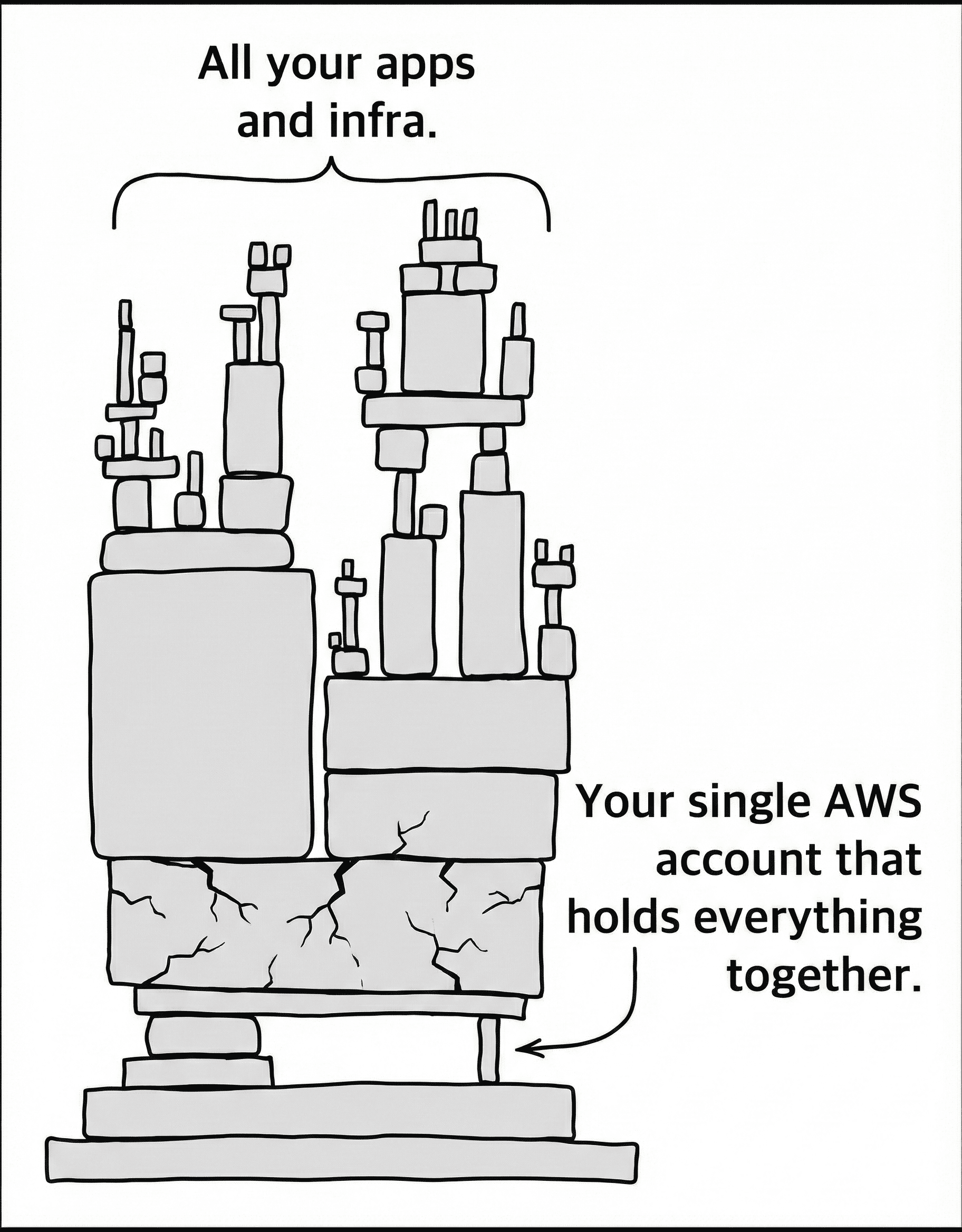
Before long, every new service inherits the blast radius and operational ambiguity of everything that came before it.

Without account separation, a bug in dev can break production and a compromise in one workload affects every other workload sharing the same boundary.
Single-account growth pushes against quotas, policy sprawl, and manual setup. The AWS model that worked early starts slowing every new launch.
When teams, projects, and environments share the same account structure, cost allocation and optimization work both get harder.
The same environment has to satisfy different controls for different workloads, which leads to fragile guardrails and audit pain.
Permissions, account access, and cross-team boundaries turn into a web of exceptions that are difficult to review and harder to maintain safely.
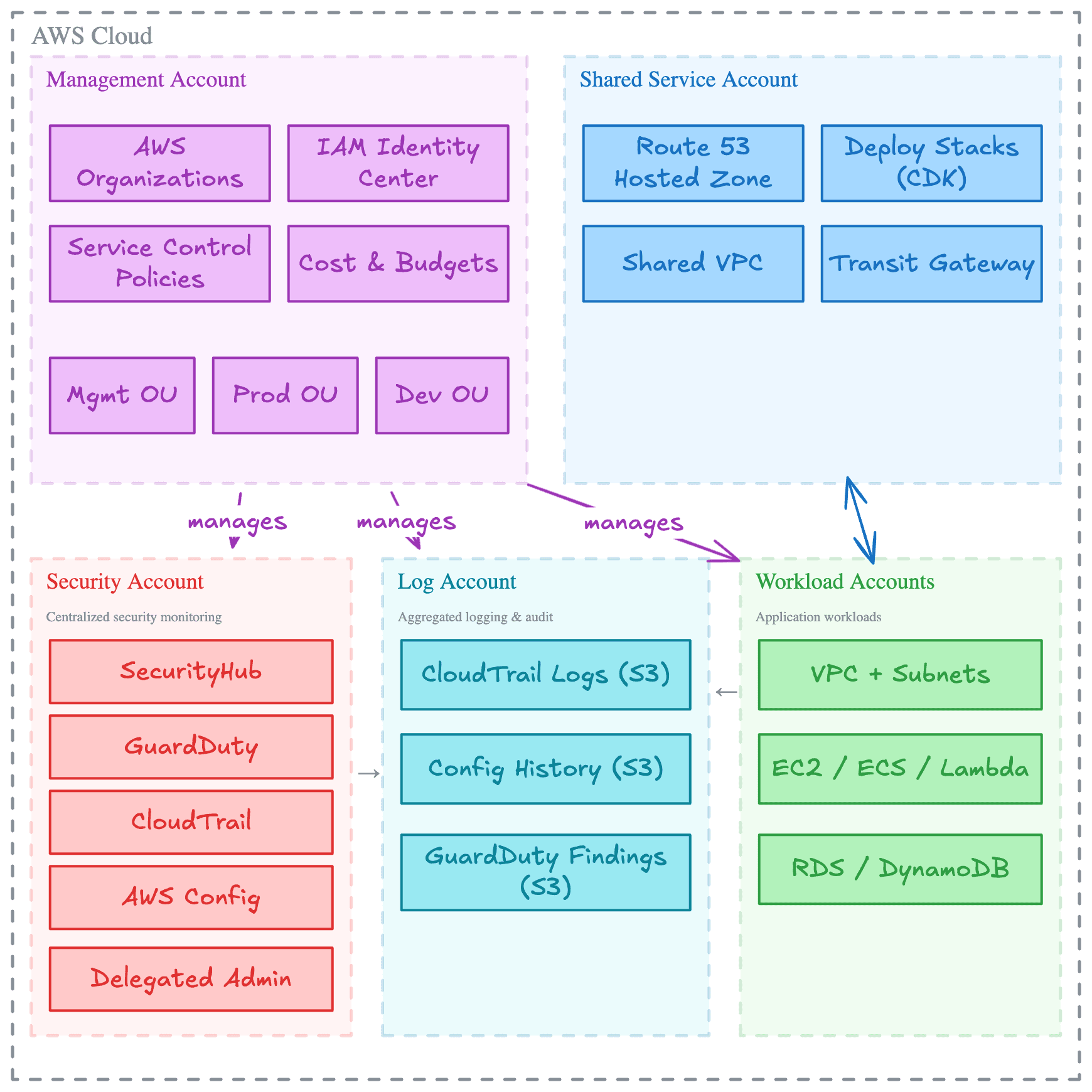
Opinionated where it matters, adaptable where your team needs room. Review the organization model, security controls, infrastructure code, and built-in guardrails before deciding if the baseline fits.
Four categories cover what arrives with the deployment: security and compliance baselines, automated account provisioning, cost and operations monitoring, and governance and deployment. No black boxes.
| Features | Description |
|---|---|
Security & Compliance | |
| Centralized Root Access | Member accounts carry no standalone root credentials. Root is managed centrally, so a lost or misused root password can no longer put an account at risk. |
| Organization CloudTrail | A single organization-wide audit trail records activity across every account, including the management account, and raises alarms on high-risk events like root usage and unauthorized API calls. |
| GuardDuty Threat Detection | Amazon GuardDuty watches every account around the clock for compromised instances, unauthorized access, and unusual API activity, with findings centralized for your security team. |
| Security Hub Posture Management | Aggregates security findings from across the organization into one dashboard and continuously scores every account against AWS and CIS benchmarks, managing the underlying AWS Config setup for you. |
| Vulnerability Scanning | Amazon Inspector continuously scans EC2 instances, container images, and Lambda functions for known vulnerabilities across the organization. |
| Sensitive Data Discovery | Amazon Macie inspects your S3 estate for exposed sensitive data, so accidental exposure is caught before it becomes an incident. |
| EBS Encryption by Default | Every new EBS volume is encrypted at rest automatically, with nothing for workload teams to configure. |
| S3 Block Public Access | Account-level public access blocking prevents any bucket or object from being exposed to the internet by mistake. |
| Strong IAM Password Policy | Enforces minimum length, expiry, reuse prevention, and complexity requirements on every account. |
| Secure Defaults | Every account inherits the same hardening in one step: default VPC removed, EBS encryption on, public S3 access blocked, default security groups locked down, and a strict password policy applied. |
| Centralized Log Archive | CloudTrail and compliance data land in a dedicated, encrypted Log Archive account with access logging and lifecycle rules for compliant, tamper-resistant retention. |
| Encrypted Alerting | Security and compliance notifications flow through KMS-encrypted SNS topics scoped to your organization, so alerts reach the right people without exposing data. |
Automated Account Provisioning | |
| Instant Account Provisioning | New accounts arrive ready to deploy to, with CDK bootstrap, encrypted asset storage, and a container registry already in place, so teams ship on day one. |
| Alternate Contacts | Security, billing, and operations contacts are set on every account automatically, so AWS notifications always reach the right people. |
| Marketing Email Opt-Out | New accounts are unsubscribed from AWS marketing email automatically. |
| Automated Account Closure | Accounts moved to the suspended unit are closed for you, with no manual offboarding steps or forgotten leftovers. |
| Default VPC Removal | The default VPC is stripped from every new account and region, so workloads run only in networks you designed. |
Operations & Cost Optimizations | |
| Cost Anomaly Monitoring | Detects unusual spending patterns across AWS services and alerts the team immediately, so overspend gets caught early. |
| Budget Alerts | Budgets notify you when actual or forecasted spend crosses your thresholds, keeping cost surprises off the invoice. |
| Service Quota Automation | Requests AWS service quota increases automatically as you grow, so limits don't block a launch. |
Governance & Deployment | |
| Configuration Drift Detection | A daily check across the management and landing zone accounts flags anything that has drifted from the version-controlled baseline. |
| Delegated Administration & Guardrails | Security services run from a dedicated security account, and organization policy families like SCPs, tag, and backup policies are enabled and governed centrally, keeping day-to-day management out of the root account. |
| GitHub Actions Pipeline | A secure CI/CD pipeline deploys infrastructure changes through pull requests using OIDC, so there are no long-lived AWS keys to store or rotate. |
| AWS Organizations via Code | Accounts, organizational units, and Service Control Policies are defined in AWS CDK, so governance changes go through code review and deploy consistently across the organization. |
No black boxes. See exactly what each control deploys in the technical reference.
Check out our roadmap to see what we're building next.
A CIS-compliant, multi-account AWS foundation built with AWS CDK. We migrate existing accounts into the framework so security guardrails, logging, identity, and account provisioning become automated instead of manual platform upkeep. See the full technical reference for everything it deploys.
* Compliance scores apply to the AWS foundation layer: organization, accounts, networking, and security services. Existing workload infrastructure may need separate remediation.
When account boundaries, IAM, logging, guardrails, or platform maintenance keep slowing the team down, the foundation rebuild solves the root cause instead of patching the symptoms.
Deployment pricing is scoped after we understand the environment, account model, migration constraints, and the amount of remediation needed around the workloads.
The value is not the initial deployment. It is the baseline the team inherits afterward: cleaner account boundaries, new accounts spun up in minutes, and a foundation that is easy to evolve.
“Before Towards the Cloud, we received a variety of proposals to provision our AWS landing zone. Danny's solution and AWS expertise stood out with comprehensive accelerators, documentation, and clearly articulated design principles. We achieved a perfect security score in days, not months, and TTC's ongoing support has been invaluable.”
The process is intentionally short: define the boundary model, deploy the landing zone, then leave the team with a baseline they can operate after the initial rollout.
We review the current AWS organization, the compliance targets, and the account model your team needs before finalizing the landing-zone scope.
We deploy the landing zone, configure the guardrails, and bring existing accounts into the new structure while minimizing disruption to the workloads already running.
We walk the team through the deployed baseline, the security posture, and the codebase so the landing zone remains understandable after delivery instead of turning into another opaque platform layer.
Take ownership of the CDK codebase, the deployment flow, and the operating model after the handover is complete.
Use the landing zone as the baseline and keep us on for updates, feature expansion, and ongoing security or platform work as the AWS estate grows.
Purchase the landing zone deployment through AWS Marketplace when procurement or billing needs to stay inside your AWS vendor workflow.
With AWS Control Tower, the controls you get are the controls AWS decided to ship. This landing zone is plain AWS CDK with the full source code in your repository, licensed for use across your entire organization: when your team needs a new guardrail, you add it the same day. And when you would rather not spend engineering time on platform upkeep, we keep it evolving for you.
From the moment the landing zone is deployed, the complete source code sits in your GitHub repository, licensed for use across your entire AWS organization. Need a stricter Service Control Policy, a different OU layout, or an extra baseline for a new compliance requirement? Your team edits TypeScript and ships it through the same pipeline. You are never stuck waiting for AWS to add a feature to a managed service.
We actively develop the landing zone: new baseline constructs, new AWS service integrations, and security updates roll out continuously. On a support plan, those improvements reach your foundation without your team lifting a finger, so full control never turns into a maintenance burden.
After deployment, you can run the foundation with your own team or keep us involved for maintenance, security visibility, cost automation, and ongoing engineering support, so your developers focus on shipping features instead of platform upkeep.
| Features | Essentials | Growth | Scale |
|---|---|---|---|
Platform Maintenance | |||
Landing Zone Security Updates | |||
Landing Zone Feature Updates | Priority Access | ||
CDK Construct Library | |||
Feature Roadmap Requests | |||
Security & Cost Visibility | |||
Cloud Security Posture Dashboard | |||
FinOps Automation (OpenOps) | |||
Support & Engineering | |||
Support Channel | GitHub Issues | Slack (24h) | Slack (12h) |
Cloud Engineer Retainer | 8h/month | Custom hours | |
CDK Construct Development | |||
Hands-on Training (Workshops) | |||
Our Landing Zone is GitOps-first and ships with security and compliance baselines already configured. Control Tower still requires a lot of manual follow-up in the console to achieve the same posture. With our implementation, your infrastructure is version-controlled in CDK, changes flow through pull requests and CI/CD, and every account is compliant from the moment it is provisioned.
AWS Landing Zone Accelerator and OrgFormation give you primitives. You still need to wire them together, decide on the account model, write the security baselines, set up the deployment pipeline, and maintain it long-term. We deliver the full implementation as AWS CDK, with all of that already done: opinionated account structure, 18+ pre-configured stacksets, SCPs, GitHub Actions pipeline, and the compliance evidence to back it up. You skip the integration work and get the full source code, licensed for use across your organization. See what every StackSet deploys in the docs.
You can. The question is how long it takes, how much roadmap time it costs, and whether the result holds up under audit. A landing zone built from scratch is typically a 3 to 6 month project for a senior engineer working part-time, plus another quarter to harden it for SOC 2 or HIPAA. We deliver the same baseline in a week because we have already made the architecture decisions on dozens of AWS environments. Your engineers stay focused on shipping features, and every line of CDK ends up in your repository, yours to customize and extend for your organization.
No. The compliance scores are a side effect of getting the AWS foundation right, not the reason to build one. Even without an audit on the horizon, the Landing Zone removes account sprawl, centralizes logging and monitoring, automates new account provisioning, and gives you safe defaults for IAM, networking, and S3. Most teams adopt it because their developers were spending too much time fighting infrastructure rather than because of a specific compliance deadline.
The entire CDK codebase lives in your GitHub repository the moment we hand it over, licensed for use across your organization. No proprietary glue, no per-account fees, no vendor lock-in. Any AWS engineer familiar with CDK can pick it up, and the architecture uses standard AWS services everywhere. If our ongoing support stops fitting, you keep the foundation and walk away.
No. We attach the Landing Zone to your existing AWS Organization and migrate accounts into the new structure without downtime. Your workloads keep running while we roll out guardrails gradually. Developers continue building with the tools they already know while the foundation improves around them. The two-phase deployment attaches to your existing organization without disrupting running accounts.
We start with a kickoff call (up to 2 hours) to gather requirements and discuss access. From there, the core Landing Zone is typically deployed within one week. The final handover and knowledge transfer session follows shortly after, so your team is confident operating it independently.
No. Your developers keep shipping while we work in parallel. The Landing Zone is deployed alongside your existing setup, and accounts are migrated without affecting running services. There is no freeze window and no downtime.
The entire Landing Zone is built with native AWS CDK and lives in your GitHub repository. Your team can modify OU structures, Service Control Policies, security controls, and account configurations through pull requests, following the step-by-step guides in the docs. The architecture scales to hundreds of accounts, so it grows with you. If you want our help, our ongoing service tiers include a cloud engineer retainer for exactly this.
If you are on one of our ongoing service tiers, we are available via Slack or GitHub Issues depending on your plan. If you chose to self-manage, you still own the full codebase and documentation. Any AWS engineer familiar with CDK can troubleshoot and resolve issues. The Landing Zone uses standard AWS services, so there is nothing proprietary that could block you.
Landing Zone deployment is scoped after the free intro call and, where needed, an AWS Foundation Assessment. The assessment clarifies the account model, migration constraints, security controls, and amount of workload remediation before we quote the build. Optional ongoing support starts from $399/month after the foundation is live. See the support comparison for the tier breakdown.
We start with a short discovery session to understand your current AWS setup and what you need, then walk you through the landing zone so you can see the account isolation, guardrails, and automation working before any of it touches your AWS environment.
Prefer to read first? Browse the landing zone documentation to see everything it deploys, or explore our other AWS Professional Services and start with the Well-Architected Review when you need a broader assessment first.